
📅 Published on September 22, 2025 🔄 Updated on May 8, 2026
Vehicle preparation for off-road driving in Romania involves checking tyres, suspension, fluids, and recovery gear before departure. Romania’s trails — from Carpathian mountain tracks to Danube Delta wetland routes — impose real demands on any 4×4 or SUV. Skipping preparation is the most common reason drivers end up stranded far from assistance. A methodical pre-trip inspection prevents the vast majority of serious incidents.
Preparing your vehicle for off-road in Romania isn’t just about having four-wheel drive. Romania’s terrain is genuinely varied — and often unforgiving. A forest track in the Apuseni Mountains behaves very differently from a washed-out trail near the Danube Delta, and neither resembles a rocky high-altitude pass in the Bucegi range. What they all share is an intolerance for mechanical unpreparedness.
Many drivers arrive with road-capable SUVs and assume that’s enough. In practice, standard vehicles — even technically capable ones — frequently lack the ground clearance, tyre condition, or recovery equipment needed when things go wrong. Romania’s remote areas also have limited mobile coverage. A breakdown doesn’t always come with an easy rescue option.
This guide covers what actually needs to be checked and why, without the filler found in most generic vehicle checklists. If you’re planning a serious off-road trip in Romania, start here.
Why Romania’s Off-Road Terrain Demands More Than a Basic Check
Romania is one of Western and Central Europe’s most compelling off-road destinations — partly because it hasn’t been manicured into submission. That’s also what makes it demanding. The Carpathian mountain network alone contains hundreds of kilometres of unsealed forest roads, many of which are seasonal, poorly signposted, and subject to sudden weather changes.
Spring and autumn are particularly hazardous. Snowmelt in higher elevations turns hardpacked trails into deep mud within hours. In the Danube Delta, spring flooding can render entire access routes impassable without warning. Even summer carries risks: afternoon thunderstorms in the mountains create flash flood conditions on narrow valley roads.
Romania’s road authority, RAR (Registrul Auto Român), oversees vehicle roadworthiness standards in the country, but those standards apply to public road use. Off-road conditions go well beyond what a standard ITP (Inspecție Tehnică Periodică) technical inspection evaluates. Your vehicle might pass its annual check without being remotely suitable for what Romania’s backcountry demands.
In short: the terrain punishes unprepared vehicles. Understanding that gap is where serious preparation begins.
What Should You Inspect on Your Vehicle Before an Off-Road Trip in Romania?
A proper pre-trip inspection covers more ground than most drivers expect. The categories below reflect what consistently matters in real-world off-road use — not just what looks good on a checklist.
| Category | What to Check | Why It Matters |
|---|---|---|
| Tyres | Tread depth, sidewall condition, correct type for terrain | Road tyres fail quickly on rocky or muddy trails |
| Suspension | Shock absorbers, bushings, ball joints, CV boots | Constant impacts accelerate wear; failures cause loss of control |
| Underbody | Skid plates, exhaust clearance, diff guards | Rocks and ruts cause damage invisible from above |
| Fluids | Engine oil, coolant, brake fluid, diff and transfer box oil | Overheating and mechanical failure under sustained load |
| Brakes | Pad thickness, disc condition, brake lines | Steep descents require reliable stopping power |
| Electrical | Battery health, alternator, lighting | Night recovery and navigation depend on reliable electrics |
| 4WD System | Engagement of all modes (4H, 4L), diff lock operation | A 4WD system that engages unreliably is dangerous off-road |
One detail most guides overlook: CV joint boots. They’re cheap to replace when intact and extremely expensive to ignore. A torn boot on a rocky trail accelerates joint failure rapidly. Check all four — or six, depending on your drivetrain — before departure, not after you hear a click.
If you’re heading into a multi-day route, the long-distance vehicle reliability and preparation guide covers extended mechanical preparation in considerably more depth, including what to carry as spare parts across different vehicle types.
Tyres and Ground Clearance — Where Most Capable SUVs Still Fall Short
Ground clearance is non-negotiable in Romania’s mountain terrain. Most factory-spec crossovers and soft-roaders offer between 170mm and 200mm of clearance. That’s enough for a gravel road. It’s not enough for a rut-heavy forest track in the Apuseni or a washed-out riverbed crossing in Maramureș county.
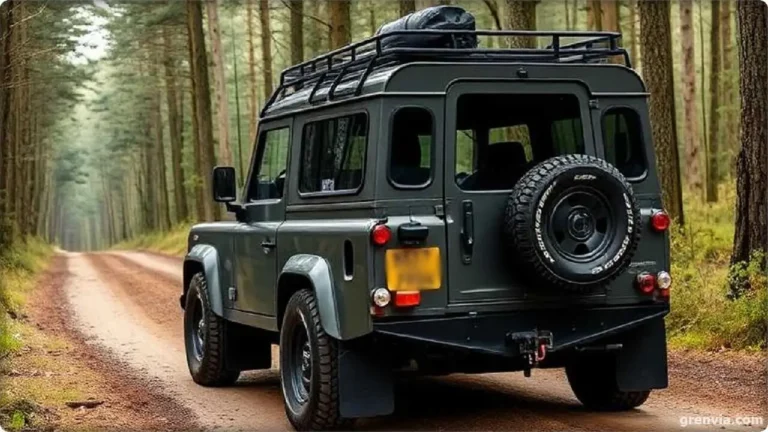
Serious off-road use in Romania generally calls for a minimum of 220mm clearance — preferably more. Vehicles like the Toyota Land Cruiser, Land Rover Defender, or lifted versions of the Dacia Duster perform well precisely because they’re built for this kind of work. A premium urban SUV, however capable on paper, often lacks the approach and departure angles needed on uneven terrain.
Tyre selection matters just as much as clearance. Many drivers underestimate how quickly highway-terrain tyres degrade on rocky trails.
| Terrain Type | Recommended Tyre | Suggested Pressure |
|---|---|---|
| Gravel / forest road | All-terrain (A/T) | 2.2–2.4 bar |
| Deep mud / wetland | Mud-terrain (M/T) | 1.5–1.8 bar |
| Rocky mountain trails | All-terrain (A/T) reinforced | 1.8–2.0 bar |
| Sand / riverbed | Mud-terrain or wide A/T | 1.2–1.5 bar |
Tyre pressures are approximate starting points. Always adjust based on load, vehicle manufacturer guidance, and trail conditions. Carry a portable compressor to reinflate after trail sections.
Experience shows that most blowouts on Romanian trails happen not from rocks punching through the tread, but from sidewall impacts on sharp-edged limestone outcrops. Reinforced sidewall construction isn’t a luxury — it’s a practical necessity on certain routes.
Recovery Gear — What You Actually Need in Romania’s Remote Areas
Recovery gear is the section most drivers skim over until they need it. Romania’s backcountry makes the omission costly. Many routes in the Apuseni Natural Park, the Retezat Mountains, or the more remote sectors of the Danube Delta are genuinely hours from the nearest mechanic or tow service — and mobile signal is unreliable across large areas.
“In isolated or mountainous zones, emergency vehicle recovery may take several hours due to access constraints and limited specialist equipment availability in rural areas.” — Romanian Road Police (Poliția Rutieră), advisory guidance for remote area travel
That guidance is understated. In practice, a self-recovery setup isn’t optional on serious routes — it’s the difference between a manageable situation and an expensive emergency.
| Equipment | Purpose | Priority |
|---|---|---|
| Kinetic recovery rope (8–11m) | Vehicle extraction from mud or ruts | Essential |
| Hi-Lift jack | Lifting vehicle for tyre change or recovery | Essential |
| Traction boards (e.g. MAXTRAX) | Sand, mud, and soft terrain traction | Highly recommended |
| Portable air compressor | Tyre reinflation after deflating for terrain | Essential |
| Shackles (bow and screw pin) | Connecting recovery gear to anchor points | Essential |
| Shovel (folding or full-size) | Clearing debris and digging out wheels | Highly recommended |
| Fire extinguisher | Engine bay fires after impact | Legally required in Romania |
A kinetic rope pulls using stored energy from stretch — it’s far more effective for mud recovery than a static tow strap and significantly less likely to cause vehicle damage. If you’re only adding one recovery item to your kit, that’s the one.
For a comprehensive guide to the specific routes where recovery gear becomes most critical, the off-road adventures in the Danube Delta article documents real trail conditions and the gear that proved necessary across multiple visits.
What Are the Legal Requirements for Off-Road Driving in Romania?
This is an area where many travel guides are dangerously incomplete. Off-road driving in Romania isn’t universally permitted, and the rules aren’t always clearly posted at trailheads.
Protected areas — including national parks, nature reserves, and the Danube Delta Biosphere Reserve — operate under specific access restrictions managed by Romanian environmental authorities. Driving off marked trails within these zones can result in substantial fines. The Danube Delta, administered by the Danube Delta Biosphere Reserve Authority (ARBDD), requires entry permits for certain sectors and prohibits motorised vehicles from many natural areas entirely.
Forest roads in Romania are managed by Romsilva, the national forestry administration. Many are accessible to private vehicles, but access gates and seasonal closures apply. Assuming a road is public because it’s on a mapping app is one of the most common mistakes drivers make.
Required documents for any vehicle driven in Romania include:
- Valid vehicle registration (talon)
- Third-party liability insurance (RCA) — mandatory, issued by Romanian-registered or EU-recognised insurers
- ITP certificate (Romanian technical inspection, or equivalent EU roadworthiness certificate)
- Vignette (rovinieta) for use on public roads — not required for private off-road land, but required for any national road transit
- Reflective vest and warning triangle (legally required in-vehicle items)
Foreign-registered vehicles are subject to the same requirements as Romanian vehicles once on Romanian roads. The rovinieta is available online via the official roviniete.ro platform and is required immediately upon entering the country on public roads.
Common Mistakes That Get Drivers Into Trouble on Romanian Off-Road Trails
Many travelers discover too late that the mistakes that ruin off-road trips in Romania aren’t dramatic — they’re ordinary oversights that compound under pressure.
Relying on Google Maps for trail navigation. Consumer mapping apps frequently show forest roads as accessible routes without indicating seasonal closures, gate restrictions, or whether the track is passable for the vehicle type. Offline maps from dedicated apps like Maps.me or Guru Maps with OSM data are far more reliable for remote navigation in Romania.
Not checking weather for the elevation you’re entering. It can be 22°C in Brașov and actively snowing at 1,600m above the Transfăgărășan. This isn’t rare. Mountain weather in the Carpathians changes faster than most visitors expect, and being caught on a high-altitude trail in sudden rain or snow with unprepared tyres is a genuinely serious situation.
Assuming fuel is available at the trailhead. Petrol stations thin out sharply outside urban areas in Romania. In remote mountain counties like Hunedoara, Gorj, or Tulcea near the Delta, filling up before a trail day isn’t optional — it’s routine planning.
Treating the first stretch of a trail as representative. Many Romanian forest tracks start well and deteriorate significantly after the first few kilometres. By the time conditions become dangerous, turning around may already be difficult. If you’re unsure about a route, local knowledge from forestry workers, hunting lodge staff, or dedicated Romanian off-road forums is worth more than any guidebook.
One of the most overlooked details: diff lock engagement on a vehicle that hasn’t used it in months. Diff locks that sit unused can seize or engage only partially. Test every four-wheel-drive mode and locking function at low speed before you’re on a trail where you actually need them.
For a broader planning framework that covers route selection, permits, and seasonal windows, the Romanian off-road adventure planning guide provides a structured approach from initial research through to day-of execution.
Frequently Asked Questions
Do I need a special permit to drive off-road in Romania?
It depends on the area. National parks and the Danube Delta Biosphere Reserve require entry permits and restrict motorised access on many routes. Forest roads managed by Romsilva are often accessible without permits, but seasonal closures apply. Always check access rules specific to the region before departure.
Is a standard SUV suitable for off-road driving in Romania?
Many standard SUVs handle gravel roads and mild forest tracks adequately. For serious mountain trails or wetland routes, minimum 220mm ground clearance, reinforced all-terrain tyres, and low-range gearing are recommended. A capable SUV with worn road tyres will underperform a modest 4×4 with proper all-terrain rubber.
What recovery gear should I carry for off-road in Romania?
At minimum: a kinetic recovery rope, hi-lift jack, traction boards, portable air compressor, and shackles. A folding shovel and fire extinguisher round out a practical kit. The fire extinguisher is also legally required in Romanian vehicles. These items cover the majority of recovery scenarios on standard Romanian off-road routes.
Can I drive on Romanian forest roads without a permit?
Many Romsilva-managed forest roads are accessible to private vehicles without a permit, though seasonal closures and access gates are common. Roads within national parks or nature reserves have stricter rules. Mapping apps frequently don’t reflect current access status, so local verification before entering remote tracks is strongly advisable.
What tyres are best for off-road driving in Romania?
All-terrain (A/T) tyres with reinforced sidewalls cover most Romanian off-road conditions well. For the Danube Delta and muddy mountain tracks, mud-terrain (M/T) tyres perform significantly better. Standard highway-terrain or touring tyres are not suitable for serious trail use and degrade rapidly on rocky surfaces.
Conclusion
Preparing your vehicle for off-road in Romania comes down to honest assessment. Not of what your vehicle is rated for — but of what condition it’s actually in, what terrain you’re entering, and whether your recovery setup matches the remoteness of the route. Romania rewards prepared drivers generously. Its trails offer genuine wilderness access that few other European countries can still match.
Check your tyres, your suspension, your recovery gear, and your documentation before you leave. Confirm access permissions for any protected area. Know where your nearest fuel stop is. None of this is complex — but skipping any part of it is how a great trip becomes an expensive one. Prepare properly, and Romania’s off-road network is one of the continent’s most rewarding places to drive.
Follow WheelsFree on Facebook
Get practical car maintenance tips, driving advice, troubleshooting guides, and useful automotive updates published regularly on Grenvia.
Follow the Facebook PageI am Georg Planko, a travel expert and a key figure at Grenvia (FreeWheels). My mission is to give you the freedom and comfort you deserve during your journeys. With a focus on reliability and a passion for the road, I ensure that grenvia.com remains your trusted authority for adventures on two and four wheels.