
Published on April 19, 2026
Electric car travel in Europe is no longer a curiosity — it’s a real option for millions of drivers planning cross-border road trips. But “possible” and “painless” aren’t the same thing, and that gap is exactly where unprepared travelers get caught out. Charging deserts, incompatible payment systems, and wildly uneven infrastructure between countries can turn a smooth holiday into a logistical puzzle.
The good news: with the right preparation, an EV road trip across Europe is not just feasible — it can cost less than driving a petrol car. The less-good news: you’ll need a different mindset, a different toolkit, and an honest look at where the system still falls short.
This guide from Grenvia breaks down exactly what to expect: country-by-country infrastructure gaps, hidden costs, the apps that genuinely help, and one EU regulation most travelers don’t discover until they’re stuck at a broken charger at 11 PM.
Yes, you can travel Europe exclusively in an electric car. Western and Northern Europe have solid fast-charging networks; Eastern Europe remains patchy. Plan charges every 150–200 km, use A Better Route Planner or PlugShare, budget for premium networks like IONITY, and carry a Type 2 cable. Expect minor friction — not showstoppers.
How Good Is Europe’s EV Charging Infrastructure Right Now?
Europe’s public charging network is large but deeply uneven. The EU counted over 630,000 public charging points across member states as of 2024, with the Netherlands, Germany, and France leading in density. Fast charging (50 kW+) is well established on major motorway corridors, but coverage drops sharply the moment you leave the TEN-T core network for rural or secondary roads.
| Country | Fast Charger Density | Main Networks | EV Traveler Rating |
|---|---|---|---|
| Netherlands | Very High | Fastned, Allego | Excellent |
| Norway | Very High | Recharge, Mer, Tesla | Excellent |
| Germany | High | IONITY, EnBW, Aral Pulse | Very Good |
| France | High | TotalEnergies, Lidl Charge, IONITY | Very Good |
| Spain | Moderate | Iberdrola, Repsol Waylet | Good |
| Italy | Moderate | Enel X, Be Charge, IONITY | Good |
| Poland | Low–Moderate | GreenWay, Orlen Charge | Manageable |
| Romania | Low | MOL Plugee, Rompetrol | Difficult |
| Bulgaria | Low | EVN, PlugPoint | Difficult |
Source: European Alternative Fuels Observatory (EAFO), 2024 data
Tesla’s Supercharger network remains the benchmark for reliability and speed in Europe — and since opening to non-Tesla vehicles across most of the continent, it’s become a genuine fallback option. IONITY covers major motorway corridors well, though its pay-as-you-go pricing without a subscription plan (~€0.69–0.79/kWh) stings compared to running on home electricity. For non-Tesla drivers, carrying a universal Type 2 cable is non-negotiable.
Which Countries Will Stress You Out — and Which Countries Won’t?
Western and Northern Europe are genuinely workable for EV road trippers. Scandinavia — particularly Norway, which has the highest EV adoption rate in the world — has infrastructure to match the enthusiasm. The friction starts east of Vienna and south of Naples.
- Low friction: Netherlands, Norway, Germany, Belgium, Denmark, France (main routes)
- Manageable with planning: Spain, Portugal, Austria, Switzerland, Italy (north)
- Needs careful routing: Poland, Czech Republic, Slovakia, Hungary, Croatia
- High difficulty — plan conservatively: Romania, Bulgaria, Serbia, Albania, North Macedonia
Most travelers underestimate how much buffer range matters in Eastern Europe. A 400 km WLTP-rated vehicle might deliver 280–310 km in real winter conditions. If your next confirmed fast charger is 180 km out with no backup, you’re gambling — and charger outage rates at some Eastern European sites run between 15–20%. Always identify a fallback charger before you leave a stop, not when you need one.
The planning discipline is the same as for any long-distance trip. For a practical framework, How to Plan Fuel Stops on Long Distance Drives applies directly to EV routing — the variables differ, but the logic doesn’t.
What Are the Real Costs of Electric Car Travel Across Europe?
EV charging costs vary more than most people expect. Fast charging on IONITY without a partner plan can reach €0.79/kWh — on par with petrol costs or worse for energy-hungry vehicles. The real savings come from hotel destination charging, slow overnight charging, or accommodation with EV points. Don’t assume electricity always means cheap; it depends entirely on how and where you charge.
| Cost Category | EV Road Trip | Petrol Car (Equivalent) | Notes |
|---|---|---|---|
| Fuel / Charging per 1,000 km | €25–75 (slow/hotel); €65–120 (fast only) | €90–140 | EV wins decisively with overnight charging |
| Toll roads | Same or discounted | Standard rates | France, Portugal, Spain offer EV discounts |
| EV travel insurance premium | 5–15% higher than baseline | Baseline | Varies by insurer; battery cover matters |
| Charging memberships | €0–25/month | N/A | IONITY Passport, Chargemap Pass, Plugsurfing |
| Ferry crossings | Standard vehicle rate | Standard vehicle rate | Some operators restrict EVs to open car decks |
Source: ACEA (European Automobile Manufacturers’ Association); IONITY, Fastned network pricing, 2024
EV-specific travel insurance is worth reviewing before departure. Standard policies often exclude roadside assistance costs related to battery failure or charging equipment incompatibility — a gap that can generate a €200–400 recovery bill in remote areas. Read the policy wording on “energy-related breakdown” specifically, not just the headline cover. Comparing EV-friendly travel insurance options is a 20-minute job that can save a miserable roadside afternoon.
What Most Guides Don’t Tell You About Cross-Border Charging
Here’s the detail most EV travel content skips entirely: under the EU’s Alternative Fuels Infrastructure Regulation (AFIR), fast chargers on the TEN-T core network must accept ad-hoc payment (no prior registration required) by July 2025. But the mandate for contactless bank card payment does not kick in until January 2027. Until that date, a legally compliant charger can still require a network-specific RFID card or app to initiate a session — meaning a traveler without that provider’s account is locked out.
This is a practical problem when a primary charger is offline and your fallback runs on a network you’ve never registered with. The workaround: pre-register with at least three major networks before your trip. IONITY, Plugsurfing, and one national-level network for each country on your route is a sensible baseline. Chargemap Pass covers thousands of stations across Europe under a single RFID card for around €3–5/month — one of the highest-value purchases you can make before a multi-country trip.
There’s also a ferry issue most EV drivers discover at the dock rather than before booking. Several operators in Scandinavia, on Adriatic routes, and in Greece classify electric vehicles as hazardous cargo under battery fire risk protocols. This can restrict EVs to open car decks, affect boarding priority, and in some cases limit availability. Check the operator’s EV policy when you book — not when you arrive.
The Best Apps and Gear for Planning Your EV Route Through Europe
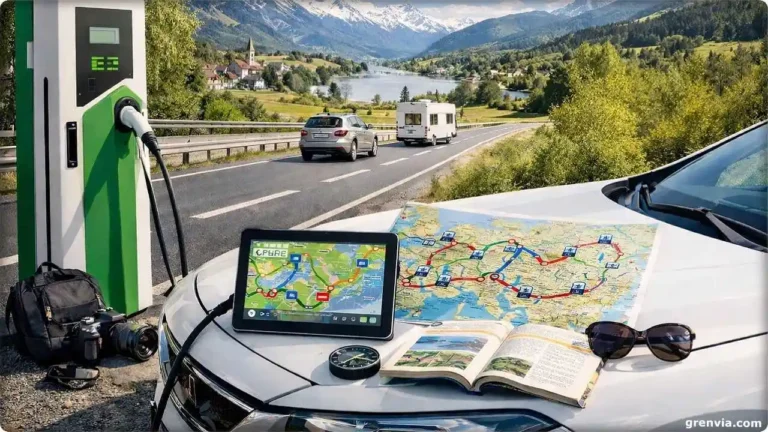
Standard navigation apps fall short for EV road trips. They don’t account for real-time charger availability, elevation-driven consumption shifts, or battery state at each waypoint. Purpose-built EV tools make a measurable difference — and they’re inexpensive compared to the problems they prevent.
- A Better Route Planner (ABRP): The most capable EV routing app available. Factors in real-world consumption, elevation, weather, and live charger status. The free tier covers most needs; the premium plan (~€2.99/month) adds live SOC sync via an OBD dongle for supported vehicles.
- PlugShare: Best for crowd-sourced charger check-ins and real-time status reports. Invaluable for identifying unreliable stations before you rely on them.
- Chargemap: Strong across France, Germany, and Benelux. The Chargemap Pass roaming card works with a wide network range.
- Electromaps: A useful supplement for the Iberian Peninsula, where mainstream apps have patchier data.
On the hardware side, a solid set of Essential Tech Accessories for Long-Distance Driving should include a portable Type 2 cable (16A, 7–22 kW rated) for hotel and campsite destination charging — don’t rely on the short, low-amperage cable most manufacturers bundle with the car. A CCS adapter if your vehicle supports dual-standard charging adds useful redundancy.
Vehicle preparation matters too. Battery health checks, tire pressure calibration (EV tires wear differently under regenerative braking load), and a software update check should all happen before departure. The Long-Distance Vehicle Reliability and Preparation Guide covers the complete pre-trip checklist.
Is Electric Car Travel Across Europe Actually Worth the Extra Planning?
For most Western and Central European routes, yes — the planning investment pays back. You get lower per-kilometer costs when using overnight or destination charging, free access to zero-emission city zones in Amsterdam, Paris, Milan, and Oslo, and a quieter, smoother long-distance experience. The trade-off is mental load: charging requires active awareness, not autopilot thinking.
- Worth it comfortably: Western and Northern Europe; accommodation with EV charging; vehicles with 300+ km real-world range
- Worth it with preparation: Central Europe (Poland, Czech Republic, Hungary); strict daily distance caps of 350–400 km; backup charger always mapped
- Think carefully first: Deep Balkans routes; vehicles under 250 km real-world range; schedules with no flexibility for a 45-minute charging detour
After driving through France, Spain, and into Portugal on an EV road trip, the biggest practical lesson wasn’t range anxiety — it was app overload. Six accounts, three RFID cards, two routing apps. Simplify before you leave: two apps maximum, one roaming card, and one backup network registered per country. Everything else adds noise without adding safety margin.
Electric car travel works in Europe. It isn’t seamless across the entire continent yet, but it’s well past the experimental stage in the west and moving forward fast everywhere else. Drive with a 20–25% buffer in your battery, verify your insurance covers energy-related breakdown, and plan your charging stops the night before each leg. The infrastructure is coming — just not uniformly, and not this year.
Frequently Asked Questions
Can you really drive across Europe in an electric car without serious range anxiety?
Yes, on Western and Northern European routes, range anxiety is manageable with basic planning. Use A Better Route Planner, keep a 20% battery buffer, and always know your nearest fallback charger. On Eastern European routes or with vehicles under 250 km real-world range, more conservative daily distances are necessary.
How much does it cost to charge an EV on a road trip in Europe?
Costs vary enormously. Fast charging on premium networks like IONITY without a subscription runs €0.69–0.79/kWh — close to petrol costs. Overnight hotel or destination charging drops that to roughly €0.20–0.35/kWh. Budget €60–120 per 1,000 km if you rely exclusively on fast chargers; significantly less with smart charging habits.
Which European countries have the worst EV charging infrastructure for travelers?
Romania, Bulgaria, Albania, Serbia, and North Macedonia present the highest difficulty for EV road trippers. Fast charger density is low, outage rates are higher, and network coverage is fragmented. Driving these routes requires careful pre-planning, conservative range targets, and fallback chargers identified at every stop.
Do I need a special adapter or membership to charge my EV across different European countries?
A Type 2 cable covers the majority of AC destination chargers. For DC fast charging, CCS is the European standard — most modern EVs support it. Membership-wise, pre-registering with Chargemap Pass, IONITY, and one national-level network per country covers most scenarios and avoids being locked out at unfamiliar stations.
Follow WheelsFree on Facebook
Get practical car maintenance tips, driving advice, troubleshooting guides, and useful automotive updates published regularly on Grenvia.
Follow the Facebook PageI am Georg Planko, a travel expert and a key figure at Grenvia (FreeWheels). My mission is to give you the freedom and comfort you deserve during your journeys. With a focus on reliability and a passion for the road, I ensure that grenvia.com remains your trusted authority for adventures on two and four wheels.