
Published on May 2, 2026
Most travelers fly somewhere famous and spend the trip inside someone else’s highlight reel. They see what’s expected, eat where they’re pointed, and come home with photos that look exactly like everyone else’s. But the best scenic road trip in Europe isn’t a city. It’s a highway — a two-lane strip of asphalt that climbs through the Carpathian Mountains of Romania and quietly changes how you think about travel.
The Transfăgărășan Highway stretches roughly 90 kilometers through southern Romania, linking Curtea de Argeș in Wallachia to Sibiu in Transylvania. It peaks at 2,042 meters above sea level near Bâlea Lake, a glacial cirque that sits like something out of a geography textbook brought violently to life. Jeremy Clarkson called it the best road in the world on BBC’s Top Gear. For once, that wasn’t a stunt. It held up.
This isn’t a bucket-list drive because it’s photogenic. It’s on the list because it demands something from you — and that’s increasingly rare in European travel.
The Transfăgărășan Highway in Romania’s Carpathian Mountains is the most rewarding scenic road trip in Europe. Open roughly late June through late October, it peaks at 2,042 meters and rewards drivers with alpine lakes, brutal switchbacks, and real silence between the turns — if you go on the right day and plan correctly.
What Makes the Transfăgărășan the Most Scenic Road in Europe?
The Transfăgărășan stands apart as the most scenic road in Europe because it combines extreme elevation change, mountain lake access, and a brutally honest road design that was never intended for tourists. Unlike the polished alpine corridors of the Grossglockner High Alpine Road in Austria or the Stelvio Pass in northern Italy, this highway was built for military utility — and that purpose makes it rawer, steeper, and more unpredictable than anything designed for comfort.
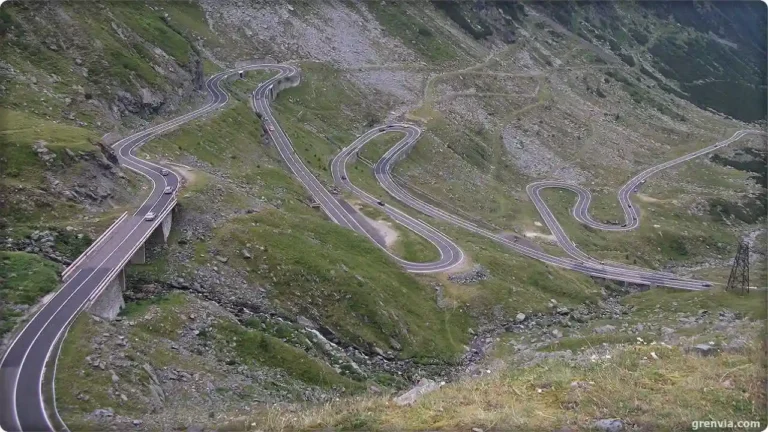
The drive starts deceptively easy. Pine forests, river valleys, a few scattered villages. Then the switchbacks begin. At certain points, the road doubles back so sharply you can look down and see the exact curve you were on two minutes ago. Near the summit, Bâlea Lake emerges from the treeline like a reward you hadn’t quite earned yet. There’s a cable car for those who want the view without the drive. Don’t take it. You’d be missing the entire point.
- Total length: ~90 km (Curtea de Argeș to Sibiu)
- Highest point: 2,042 meters (near Bâlea Cascadă tunnel)
- Road type: Two-lane mountain highway, full tarmac on the main surface
- Country: Romania, southern Carpathian Mountains
- It costs: Nothing — the road has no toll
| Feature | Transfăgărășan (Romania) | Grossglockner (Austria) | Stelvio Pass (Italy) |
|---|---|---|---|
| Peak Elevation | 2,042 m | 2,504 m | 2,757 m |
| Scenic Section Length | ~35 km | ~48 km | ~24 km |
| Toll Cost | Free | €38–€43 per car | Free |
| Typical Seasonal Closure | Late Oct – Late Jun | Nov – May | Nov – May |
| Crowd Level (August) | High near Bâlea | Very High | Extremely High |
| Tunnel on Route | Yes (887 m, year-round) | No | No |
Source: Romanian National Roads Administration (CNAIR); Austrian Federal Ministry for Climate Action (Grossglockner data)
What Does the Drive Actually Feel Like on This Road?
After driving through the northern approach in early September, one thing stands out immediately: the silence between stops. Between the switchbacks there are long stretches where it’s just the road, the tree line dropping away below, and the sound of your engine working hard against the gradient. That’s not something any city itinerary offers you.
The road surface varies more than people expect. The lower sections are smooth and well-maintained. Higher up — especially near Bâlea Lake — frost damage shows in the asphalt, lanes narrow, and passing an oncoming vehicle requires nerve and patience in equal measure. Most travelers underestimate how much concentration the upper section demands. It’s not dangerous in reasonable conditions, but it doesn’t let your mind wander either.
Sheep crossings are common. Unannounced. Unhurried. Budget for them, because the shepherds certainly haven’t.
What Hidden Costs and Risks Are Drivers Not Warned About?
The real risks of driving the Transfăgărășan include seasonal closure fines, altitude-related mechanical strain on rental vehicles, and almost no mobile signal above 1,500 meters. These aren’t unusual for alpine mountain roads, but they catch first-timers off guard in ways that cost money — or worse.
What most guides don’t tell you
The Transfăgărășan was constructed between 1970 and 1974 under Nicolae Ceaușescu’s direct orders — a military supply route commissioned after the 1968 Soviet invasion of Czechoslovakia alarmed the Romanian regime into wanting a defensible Carpathian crossing. Official Romanian records acknowledge dozens of construction deaths; independent historical research places the total significantly higher, with some estimates citing nearly 40 fatalities per kilometer of the most difficult upper section. The road’s military DNA is visible in the gradient choices: no civilian engineer would have designed curves this aggressive. That’s not a curiosity for trivia nights. It’s why some hairpins feel more hostile than scenic.
Driving outside the legal access window carries real consequences. The high-altitude section is officially closed by Romanian authorities from approximately late October through late June each year. Attempting it outside this period risks a fine of up to 2,900 RON — roughly €580 — and more importantly, genuine safety exposure from black ice, unmarked snow depth, and zero emergency services coverage above the treeline.
- Car rental insurance: Standard European rental coverage may dispute damage claims on mountain sections — confirm before pickup
- Fuel: No stations exist on the upper section; fill up fully in Curtea de Argeș or Sibiu before starting
- Signal: Mobile data drops significantly above 1,500 m — download offline maps before you go
- Emergency kit: Romanian law requires a warning triangle, reflective vest, and fire extinguisher in every vehicle
- Tire rating: If visiting in late June or early October, verify your rental has all-season or mountain-rated tires
When Should You Actually Drive the Transfăgărășan Highway?
The best time to drive the Transfăgărășan Highway is mid-July through early September, when the road is fully open, snow is absent, and conditions above 1,800 meters are stable. Outside this window, the upper section may appear passable but deteriorates quickly — and the fine for ignoring closure signs is the least of your problems.
| Month | Road Status | Crowds | Notes |
|---|---|---|---|
| Late June | Opening (variable) | Low | Snow patches likely near summit; check CNAIR alerts |
| July | Fully open | Medium | Best balance of weather stability and manageable traffic |
| August | Fully open | High | Peak season; weekend traffic jams form near Bâlea Lake by midday |
| September | Fully open | Medium–Low | Best light for photography; cooler air; fewer stops required |
| Early October | Open (watch forecasts) | Low | First snow possible above 1,800 m; closure risk rises sharply |
| Late Oct – Late Jun | Closed (upper section) | — | Fine risk up to €580 + genuine safety hazard; don’t attempt it |
Source: Romanian National Roads Administration (CNAIR) — official seasonal closure status at www.cnair.ro
The practical move: arrive at the northern entrance near Curtea de Argeș before 9am on a weekday in July or September. You’ll have the lower switchbacks largely to yourself and reach Bâlea Lake before the cable car crowd arrives from the other side.
What Gear, Rentals, and Insurance Do You Actually Need?
You don’t need a 4×4. You do need a car with solid brakes, a full tank, and travel insurance that explicitly covers mountain road driving. Many travelers skip that last check and then spend three uncomfortable days arguing with a rental company over a stone chip that happened above 1,800 meters.
For most of the route a standard compact car handles everything comfortably. The Transfăgărășan is fully paved on the main driving surface — what changes is the gradient and the tightness of the turns, not the terrain type. A compact SUV offers more brake confidence on the long downhill stretches and a slightly better sight line on blind corners. A high-roof van or motorhome is impractical above Bâlea Cascadă due to width constraints and gradient stress on the transmission. If you’re building a longer overland trip, the Best Motorhome Routes Europe: Top 10 Must-Drive Roads covers which alpine roads accommodate larger vehicles and which don’t.
- Ideal rental: Compact sedan or small SUV — confirmed with all-season tires if driving near season edges
- Dash cam: Strongly recommended for documentation; models from Garmin or Nextbase offer reliable footage at altitude
- Offline maps: Download Romania in full before leaving mobile range — Maps.me or Google Maps offline both work
- Travel insurance: Confirm coverage includes mountain road driving and potential medical evacuation; some policies exclude roads above 2,000 m
- Romanian vignette: Required for all vehicles using national roads — costs approximately €3–€7 depending on duration, available online or at border crossings
Pre-departure logistics matter more than most people plan for. The Road Trip Planning Guide: Long Drives Done Right covers fuel planning, pacing strategy, and overnight stop logistics that apply directly to a Carpathian mountain route like this one.
Is This One Road Worth More Than Any Destination?
It’s not really a comparison — it’s a values question. If travel is about accumulating famous places, Rome wins every time. But if the measure is quality of experience per hour, the Transfăgărășan is genuinely hard to beat on the European continent. You’re not consuming it. You’re operating inside it.
Most popular European destinations are experienced passively. You stand in a square. You look at something old. You eat. The Transfăgărășan doesn’t work that way. You’re navigating. You’re making real decisions — pace, line, moment to stop. You’re reading the mountain as it changes around you. For a lot of drivers, that turns out to be the kind of engagement they were actually looking for all along. They just didn’t know it had a name.
For more routes that require something back from the driver, Top Scenic Drives In Europe To Experience Once is a practical companion guide built on the same philosophy.
Frequently Asked Questions
Is the Transfăgărășan Highway free to drive?
Yes, the road itself has no toll. However, Romania requires a vignette (rovinieta) for all vehicles on national roads — costs run approximately €3–€7 depending on duration and vehicle type. Buy it online before entering Romania or at official border crossing points. Driving without one risks a fine of up to 1,000 RON.
Can you drive the Transfăgărășan in a standard rental car?
Yes. A standard sedan handles the full open section without issue in good weather. Ground clearance isn’t the concern — the road is fully paved. What matters is brake confidence on the long downhill stretches and comfort with blind, tight switchbacks. Confirm your rental insurance covers mountain roads before picking up the vehicle.
How long does the full Transfăgărășan drive take?
The 90-kilometer route takes roughly 3 to 4 hours without stops. With time at Bâlea Lake, a stop at Vidraru Dam, and the inevitable sheep crossing, budget a full day. Most drivers approach it as a day trip from Sibiu or Brașov; overnight accommodation exists near both ends of the route for those who want a slower pace.
Is travel insurance worth it for driving in Romania?
Strongly recommended. Basic EU car rental coverage handles third-party liability but typically excludes breakdown above signal range, altitude-related mechanical damage disputes, and medical evacuation from remote mountain sections. The upper Transfăgărășan sits well outside ambulance response range for most of the season. Verify specifics with your insurer before departure, not after.
The Road Is the Point
The Transfăgărășan doesn’t ask you to admire it from a platform or rate it afterward. It asks you to drive it — all 90 kilometers, at your own pace, on your terms. That’s becoming rare in European travel. The road is free, the mountain is genuine, and the experience holds up long after you’re home. If you’re planning a scenic road trip in Europe and haven’t put Romania’s Carpathian highways on the map yet, you’re missing the most honest argument the continent still makes for driving somewhere instead of flying there.
Follow WheelsFree on Facebook
Get practical car maintenance tips, driving advice, troubleshooting guides, and useful automotive updates published regularly on Grenvia.
Follow the Facebook PageI am Georg Planko, a travel expert and a key figure at Grenvia (FreeWheels). My mission is to give you the freedom and comfort you deserve during your journeys. With a focus on reliability and a passion for the road, I ensure that grenvia.com remains your trusted authority for adventures on two and four wheels.