
📅 Published on December 12, 2025 🔄 Updated on May 5, 2026
I remember the first time I woke up to the jagged peaks of the Dolomites, feeling like I’d found paradise, only to realize I was one knock away from a massive wild camping fine. Many travelers assume any quiet pull-off is fair game, but Italian authorities have significantly ramped up enforcement in 2026. If you aren’t careful, that “free” view could cost you upwards of €1,000 in penalties.
In this guide, I’ll break down the specific rules for wild camping in the Dolomites and share exactly where you can legally park overnight without looking over your shoulder for the police. Understanding the local regulations at hotspots like Tre Cime di Lavaredo is the only way to protect your budget and your peace of mind.
I’ve spent weeks navigating these mountain passes and speaking with local rangers to get the facts straight. From designated rest areas to the strict no-camping zones, here is everything you need to know to enjoy the Italian Alps responsibly and legally.
Forget “wild camping” in the Dolomites—it’s largely illegal and heavily enforced, particularly in the most scenic areas. Your vehicle must be considered parked, not camped. This means no leveling blocks, no awnings, no outdoor furniture, and no occupying space beyond the vehicle’s footprint. The primary keyword, safe overnight parking Dolomites, leads to a core intent: finding designated, fee-based, or legally permissive parking lots and aree di sosta (motorhome stops).
Expect to pay €15–€45 per night at famous trailheads like Rifugio Auronzo or seek out local aree attrezzate (equipped areas) for better value and legal peace of mind. For a full overview of overnight logistics for road trips including camping, parking, and legal considerations across regions, the central planning guide covers all three scenarios.
Decoding the Law: Where to Find Safe Overnight Parking Dolomites
For any road-tripper, the promise of waking up to a sun-drenched Dolomite peak right outside your van window is the ultimate goal. However, Italy’s approach to overnight stays outside of campsites is a complex patchwork of regional and municipal ordinances. As a road veteran, I can tell you the stakes are higher here than in many other parts of Europe—fines are substantial, and the community is protective of the UNESCO World Heritage Site status. You absolutely must understand the core legal distinction to ensure your safe overnight parking Dolomites experience remains safe and legal.
The Crucial Legal Distinction: Parking vs. Camping
In Italy, the national law—specifically the Highway Code, Article 185—distinguishes between simply parking a motorhome/van and camping.
Parking (Sosta)
This is generally permitted wherever a car can legally park, provided you adhere to three strict rules:
The vehicle rests only on its wheels (no jack stands or leveling blocks).
No fluids are emitted (no dumping gray/black water).
The vehicle does not exceed its dimensions (no awning, tables, or chairs outside).
Camping (Campeggio)
This involves deploying accessories or extending the vehicle’s footprint beyond its body, and it is strictly prohibited outside of authorized campgrounds and motorhome areas.
Important
While Article 185 exists, local municipalities in the Dolomites often pass stricter bylaws, specifically banning overnight parking for campers in scenic areas like Val Gardena or near Lago di Braies, often with signage reading “Divieto di Campeggio e Sosta Notturna” (Prohibition of Camping and Night Parking).
The Local Dilemma: Wild Camping and the Grey Area
Many travelers believe they can simply pull over on a mountain pass (passo) and sleep. While you will see people doing this, especially on popular passes during the high season, it is a risk. Authorities in the autonomous province of South Tyrol (Alto Adige/Südtirol), which contains much of the Dolomites, are known for their strict enforcement to protect the environment.
Tip: When you arrive, check the immediate area for any small, laminated, or metal signs. These hyper-local regulations are usually the most restrictive and, unfortunately, often written only in Italian and German.
For peace of mind and genuine security, your safest bet involves paying a fee for designated parking.
Official and Recommended Paid Parking Spots
The best views often come with a mandatory fee and strict regulation. These spots, while costing money, are usually patrolled, have security cameras, and provide the absolute best access to early morning hikes.
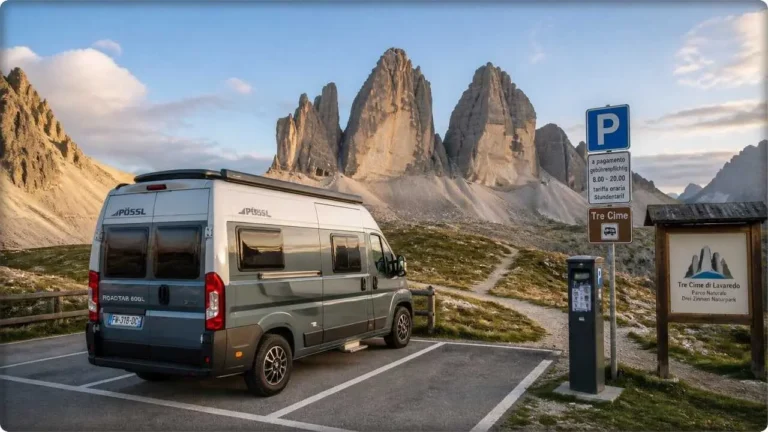
Tre Cime di Lavaredo (Rifugio Auronzo)
This is the holy grail of Dolomite van life—the ability to wake up at 2,340 meters (7,677 feet) with the Tre Cime massif right there.
The Spot
Large, high-altitude parking lot at the end of a private toll road.
The Price
The toll road is expensive, typically around €45-€50 for a motorhome/camper van for 24 hours (paid at the gate near Misurina). The charge is a mandatory contribution for road maintenance and environmental preservation.
The Rules
Overnight sleeping is allowed inside the vehicle, but camping is strictly forbidden. You must stay within your parking stall. This is the definition of legal, safe overnight parking.
Lago di Braies (Pragser Wildsee)
This iconic lake has seen its regulations tighten significantly in recent years due to overcrowding.
The Spot
Parking lots P1 to P4.
The Rules
Access and parking are heavily regulated, especially during peak summer months (usually mid-July to mid-September). Overnight parking is typically only allowed in the P4 lot, often at a high cost (e.g., €35/day) and must be pre-booked online. This helps manage the influx of tourists and ensures compliance.
Cortina d’Ampezzo and Val Gardena
In the more developed valleys, your options are often limited to dedicated parking or campsites.
In areas like Val Gardena, wild camping or overnight parking outside designated zones is strictly prohibited. The local community is very direct on this, as seen in official tourism materials.
Look for a local Area Attrezzata (Equipped Area). These are dedicated motorhome parks with basic services (water, dump station, electricity) but without the full amenities of a luxury campground. They are typically cheaper than a full camp site.
Practical Security Checks for Road-Trippers
As someone who relies on my vehicle as my home, my workshop, and my mode of travel, I prioritize security over a marginally better view. A truly safe overnight parking Dolomites spot is less about the vista and more about an uninterrupted night’s sleep.
Choosing Your Night Stop: The Veteran’s Checklist
The most secure locations are always those that offer a sense of community or have an active surveillance presence.
| Location Type | Security Profile | Legal Standing | Value/Price |
| Dedicated Campgrounds/Sites | High (Staff, gates, CCTV) | Fully Legal | Low Value / High Price |
| Aree Attrezzate (Motorhome Areas) | Medium (Designated, services, community) | Fully Legal | High Value / Medium Price |
| Toll Road High-Altitude Parking | Medium (Staffed entry, high traffic) | Legal Parking Only | Low Value / High Price (for a parking lot) |
| Public Parking Lots (Towns) | Variable (Look for CCTV/lighting) | Check Local Signs (Risky) | High Value / Low Price (if free) |
My advice? Always check the app Park4Night. While not a legal document, it offers invaluable, up-to-date user reviews on local enforcement and security, often with photos and recent experiences. It’s the digital word-of-mouth that seasoned van lifers rely on.
Vehicle Safety and Gear Theft Prevention
The Dolomites are generally safer than many major European cities, but a vehicle packed with expensive gear (lenses, drone equipment, climbing gear) remains a target.
Never leave valuables visible.
My mechanic’s toolkit alone is worth a small fortune. I keep all expensive electronics and essential tools stored under lock and key, even inside the van.
Use simple deterrents
A steering wheel lock or a small, motion-activated alarm can be enough to send a casual thief elsewhere.
Insurance Matters
This is the angle most blogs ignore. Before your trip, verify that your comprehensive vehicle insurance and your traveler’s health policy (Get a quote for international road trip insurance here) explicitly cover theft from a motorhome and any potential medical emergencies that could arise from a difficult high-altitude parking situation. Do not assume your home country’s policy extends to Italy with the same coverage level.
The Unique Angle: Tax Implications of Long-Term Stays
Many road-trippers don’t consider the financial implication of a prolonged stay. Staying in a legally registered campsite or motorhome area means you are paying the local Tourist Tax (Imposta di Soggiorno).
Why it matters
Paying the tax, even through a dedicated parking area, officially registers your presence. In the rare event of a legal issue or a vehicle problem, this documented, legal status can greatly simplify interactions with local authorities, police, or your own insurance company. Trying to save a few euros by skirting a legal parking fee could cost you thousands in the event of an accident or theft claim where you were illegally parked.
Finding Designated Motorhome Stops (Aree Attrezzate)
The best compromise between cost, comfort, and legality is finding one of the Dolomites’ excellent, dedicated motorhome areas—the Aree Attrezzate. These spots are purpose-built to cater to the van life community.
Aree Attrezzate offer more than just a place to park. They are the practical backbone of a long-term road trip, providing essential services often impossible to manage discreetly in a public parking lot.
Refueling and Recharging
Look for spots with an electrical hookup, especially if you run a portable refrigerator or need to charge camera equipment for tomorrow’s sunrise shoot.
Water and Waste Disposal (Black/Gray Water)
You must dispose of waste legally. Illegal dumping, even of gray water, is an environmental crime and a public health hazard. An Area Attrezzata will have a Camper Service point for clean, hassle-free disposal.
Long-Term Stays
If you plan on a few days of serious hiking, you may need a base camp. I often use a service for discounted camping and accommodation bookings to secure an affordable, multi-night stay at an Area Attrezzata near a major trailhead like Seceda or Alpe di Siusi.
Motorhome Parking Spot Examples and Services
As an experienced auto mechanic, I also appreciate the physical security of a well-maintained lot. Gravel or paving, proper lighting, and clearly defined spaces prevent unnecessary wear and tear on your vehicle and make late-night arrivals far easier.
| Location (Near) | Type of Spot | Typical Cost (per 24h) | Key Services |
| Pieve di Cadore | Area Sosta Camper | €15 – €25 | Water, Electric Hookup, Waste Dump |
| Sesto/Sexten | Area Attrezzata | €20 – €30 | Showers, Toilets, Full Camper Service |
| Passo Giau (Parking) | Simple Parking Lot | Free (Check Signs Closely!) | None |
| Cortina d’Ampezzo (Tofana) | Paid Parking Lot | €10 – €20 (No overnight) | Daytime Parking Only |
Attention
Never trust a free, unmarked spot right next to a major tourist attraction. These are almost always the most heavily monitored areas, and fines are practically guaranteed. The only consistently safe bet is a dedicated Area Sosta or a registered campground.
Law Enforcement and Security Checks: What to Expect
The South Tyrol (Bolzano) and Veneto regions take environmental preservation seriously. The enforcement of the no-camping rule is strict, especially during the high seasons of summer and winter. This isn’t your typical light-touch European enforcement; the local Carabinieri (military police) and Forest Guards are active.
The Standard Security Check Procedure
If you are parked in a questionable spot—such as a side road, a trail head parking lot without explicit permission, or, worst of all, with your awning deployed—you are likely to be checked.
Vehicle Inspection
Authorities will first check if your vehicle is parked or camped (i.e., checking for those illegal leveling blocks, extended windows, or outdoor equipment).
Document Request:
They will request your documents: Passport or EU ID, Vehicle Registration, and Driving License. This is when your legal status matters most. Make sure to have your documentation organized. Consider storing digital backups in a secure cloud service like Dropbox or Google Drive for emergencies, even using a travel VPN service (Secure your documents with NordVPN – 50% Off) for safe access abroad.
The Fine
If you are found to be illegally camping, the fine can range from €100 to €500 or more, depending on the local bylaw and the area (fines are higher in protected nature zones). They are rarely lenient, and you must pay or appeal the fine locally.
Essential Gear for Discretion and Safety
Being discreet is critical for a smooth journey. It’s not just about obeying the letter of the law but respecting the community.
Thermal Covers
Use internal thermal screen covers for all your windows. This not only insulates the van (a must-have for those cold Dolomite nights, even in summer) but also provides privacy, making your van look less “inhabited” from the outside.
Low-Profile Cooking
Avoid cooking outside. If you are using a portable camping stove, keep it inside the van with adequate ventilation. The smell and sight of an outdoor cooking setup is an immediate red flag for enforcement that you are camping.
Navigation and Mapping
Use reliable mapping tools that are specifically geared toward the van life community. I personally recommend combining the offline capabilities of Maps.Me with the user-generated data from Park4Night. This combination helps you avoid those dead-end roads or areas that are too tight for a larger vehicle. For reliable satellite navigation that works deep in the valleys, check out the deals on Garmin Overlander GPS units on Amazon.
Protecting the Landscape: The Road-Tripper’s Ethic
Ultimately, the best way to ensure that future road-trippers can also enjoy safe overnight parking Dolomites is to demonstrate a commitment to environmental stewardship. The reason regulations are so strict is precisely because irresponsible travelers have damaged sensitive high-alpine environments.
The “Leave No Trace” Mandate
This is not optional—it is the price of admission for this kind of travel.
Waste Management
Carry a minimum of three trash bags: one for non-recyclable waste, one for recyclables, and one specifically for wet/smelly trash. Do not use public bins near trailheads; they are often meant for day-hiker trash only and can quickly overflow. Carry it out to a larger town center bin or proper disposal site.
Grey and Black Water
Absolutely no dumping. You must use dedicated Camper Service points for grey water and chemical toilet disposal.
Fires
Ground fires are strictly forbidden. Use designated grills at campgrounds only. A portable fire pit that leaves no ash behind is a good alternative but still highly discouraged in the forested areas of the Dolomites.
Health and Safety: Preparing for Altitude
Sleeping at high altitude (as you would at Rifugio Auronzo) is taxing, even if you’re fit. Many first-time van lifers forget about the thin air and plummeting temperatures.
Altitude Awareness
Be aware of the signs of Acute Mountain Sickness (AMS)—headache, nausea, and dizziness. If you feel unwell, descend to a lower altitude immediately.
Cold Preparedness
Even in July, a night at 2,000+ meters (6,500+ feet) can see temperatures drop to near freezing. Ensure your sleeping bag is rated for or lower. I use a multi-layered system and always keep an emergency Mylar blanket (Browse high-altitude hiking and safety gear) on hand, as you never know what the weather will bring.
Frequently Asked Questions for Dolomites Parking
Is it legal to sleep in my car in Italy?
Yes, under the national Highway Code (Article 185), sleeping in your car or van is legally considered parking and is allowed, provided you do not deploy any accessories outside the vehicle (no leveling blocks, no awnings, no steps, and no outdoor chairs).29 However, local Dolomite municipalities often have stricter bylaws that ban all overnight stays, even in parked vehicles, in sensitive areas.
How much does it cost for overnight parking at Tre Cime di Lavaredo?
The cost is an all-inclusive toll fee for the access road up to Rifugio Auronzo parking, which typically ranges from €45 to €50 for a motorhome or camper van for 24 hours. This fee is mandatory and grants you legal overnight parking inside the vehicle (but not camping).
Where can I legally dump my gray and black water in the Dolomites?
You must use a designated Camper Service point, which is found at Aree Attrezzate (equipped motorhome areas) or official campgrounds. Illegal dumping is subject to high fines and is extremely harmful to the sensitive alpine environment. Using apps like Park4Night can help you locate the nearest service point.
Are there any free overnight parking spots in the Dolomites?
Genuine, legally confirmed free overnight parking Dolomites spots are rare and shrinking, often found only in the quiet parking lots of small, non-tourist-focused villages. Any “free” spot near a major attraction (like Lago di Braies or the famous passes) should be treated with extreme caution, as they are likely monitored for illegal overnight stays.
What is the fine for illegal camping in a motorhome in the Dolomites?
Fines for illegal camping (deploying an awning, using leveling blocks, or simply being in a prohibited zone) generally start at €100 and can be as high as €500 or more, especially in protected nature reserve areas.30 Enforcement is actively carried out by local police and forest guards, particularly during the high season.
The Road Veteran’s Final Word
The Dolomites offer some of the most spectacular road-tripping and hiking on the planet. To enjoy it responsibly and without a massive fine, you must respect the local rules. The difference between a memorable trip and a costly nightmare often boils down to preparation and a willingness to pay for a legal, safe overnight parking Dolomites spot.
Accept that the stunning trailhead views come with a tariff. Budget for the Area Attrezzata and prioritize legal parking over a risky, potentially illegal roadside stop. This approach ensures your vehicle remains secure, your travels are stress-free, and this beautiful landscape is preserved for the long term.
Links Suggested
For the latest official road tolls and information regarding Tre Cime di Lavaredo, I recommend checking the Auronzo Tourist Information website
Always consult the Italian government’s official Ministero delle Infrastrutture e dei Trasporti for the most current Highway Code amendments (Article 185).
Ready to plan your itinerary?
Start comparing the best multi-day Dolomites tours and skip-the-line passes now.
Follow WheelsFree on Facebook
Get practical car maintenance tips, driving advice, troubleshooting guides, and useful automotive updates published regularly on Grenvia.
Follow the Facebook PageI am Georg Planko, a travel expert and a key figure at Grenvia (FreeWheels). My mission is to give you the freedom and comfort you deserve during your journeys. With a focus on reliability and a passion for the road, I ensure that grenvia.com remains your trusted authority for adventures on two and four wheels.